
THE MINISTRY OF TRANSPORTATION AND ITS PARASTATALS: SYMBIOTIC RELATIONSHIP FOR NATIONAL DEVELOPMENT, GROWTH AND PROGRESS
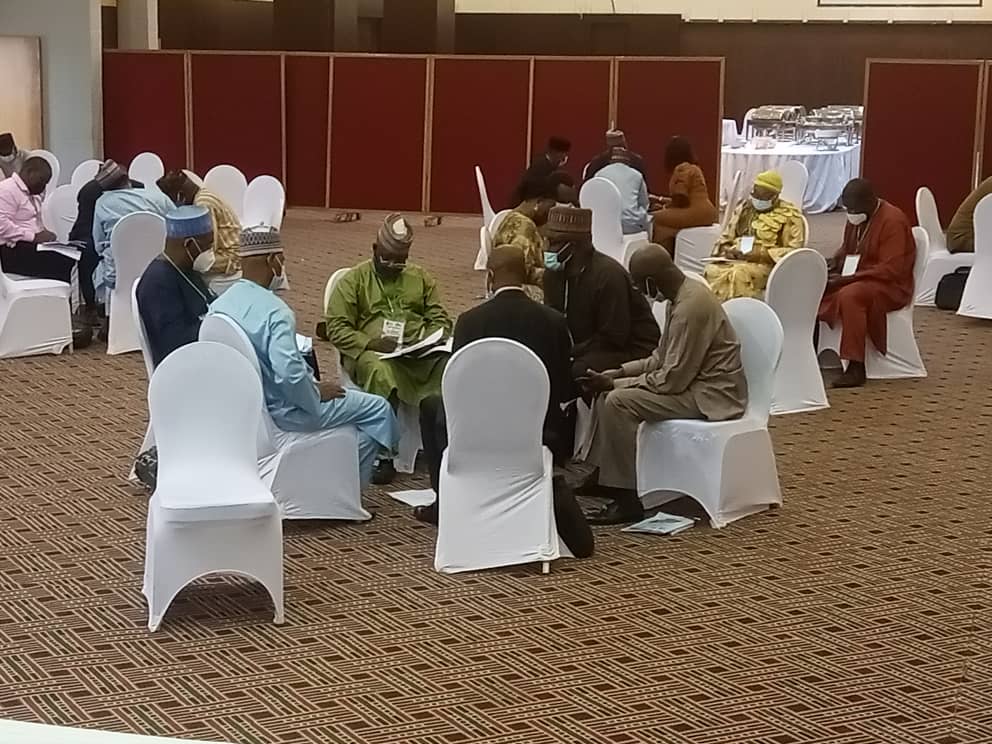
Keynote Address Delivered by Malam Adamu Fika at a 4-Day Sensitisation and Capacity Building Retreat for the Ministry of Transport and Its Parastatals, at Ibom Resort, Akwa Ibom.
I would like to thank the SAVANNAH CENTRE FOR DIPLOMACY, DEMOCRACY AND DEVELOPMENT for inviting me to give an address at this retreat.
I note with satisfaction that one of the objectives of the Retreat is capacity building for the staff of the Ministry and its parastatals. As we all know there can be no meaningful development in the absence of cohesion and mutual understanding between Ministers as policy & decision makers, and the civil servants in the Ministries and parastatals as implementers and executors of approved policy and decisions of the Government.
It is only in the last thirty years that capacity building has become an issue. Prior to mid 1980s capacity building was a routine part of governance; it happened regularly and in various forms. Workshops were organised to last up to a week.
Short term training courses for groups lasting a week or more, as well as training courses lasting a couple of months and longer up to one year were conducted. Officers selected on such courses based on their annual performance, and the need for further training as indicated in individual annual performance reports. This is the period when all matters of the public service were decided on merit and merit alone, without interference from the political leadership in accordance with the pledge made by the country’s founding fathers. In January 1954, Sir Ahmadu Bello of the Northern People’s Congress (NPC), Dr. Nnamdi Azikwe of the National Council of Nigerian Citizens (NCNC), Chief Obafemi Awolowo of the Action Group (AG), Malam Aminu Kano of the Northern Elements Progressive Union (NEPU) and Prof. Eyo-Ita of the United Nigeria Independence Party (UNIP) committed their respective parties to the principle that:
“All public service questions including appointments, promotions, transfers, postings, dismissals and other disciplinary matters should be kept completely free and independent of political control. We hope therefore that the traditional principle of promotion according to qualification, experience and merit without regard to race will be maintained.”
All such matters were vested in the Public Service Commission, the Police Service Commission and the Judicial Service Commission.
The two top positions in a Ministry were those of the Minister and the Permanent Secretary. In a section of the 1960/1963 Constitution the following provision was provided:
“Where any Minister of the Government of the Federation has been assigned with responsibility for any department of government, he shall exercise general direction and control over that department; and subject to such division and control the department shall be under the supervision of a Permanent Secretary, whose office shall be an office in the Public Service of the Federation.: Provided one or more departments may be placed under the supervision of one Permanent Secretary”
In 1988 a new system of Public Service was introduced when Decree No. 43 was promulgated, vesting the power of appointment, promotion, discipline, transfers, etc in the Ministers in respect of the staff in their respective Ministries.
Similarly, the supervisory function, hitherto vested in the Permanent Secretary, was also transferred and vested in the Ministers. Thus all public service questions were brought in completely under political control. The merit based system of the public service was dumped and in its place a new system on political consideration and patronage has taken deeply in the conduct of public affair at all levels and in all spheres. Political scientists have always argued that allowing public matters to be brought under political control is the surest means of breeding corruption in public life and making the public service inefficient and ineffective. On page 397 going into page 398 (1923 Edition) of his book, A Grammar of Politics, Prof. H. J. Last stated that:
“It is clear from the experience of every modern state that the power to control appointment to the public service makes certain, when its possessed by the political executive, an ample corruption of public life.”
Further down the same page, Laski wrote,
“Unless the Public Service as a body of officials, beyond the reach fo the executive, it is inevitable that the mind of the Minister should be devoted not to the problems of his office but to the need of rewarding his followers; and the assassination of President Garfield is the only the Climax of that need will involve. There will grow up in every state a race of men who live by giving service to or other of the the parties in the state in return fora brief period as an official, a career for which they have neither training nor competence. And is further clear that they will use. The past, they fill not for the performance of their duties but for lining their own pockets at the public expense.”
The veracity of the quotation above has been proven by the situation in Nigeria since the 1988 reorganisation of the Civil Service to date.
The working relationship between a minister and his permanent secretary was further clarified in the “Guide to Procedures of the Government”. The minister was the “boss” who was personally & politically responsible for each and every act in the ministry. He worked through, and with the officials of his Ministry, particularly the permanent secretary, whose duty it was to advise the minister impartially & to the best of his ability. The minister still had the final say, even though that final say depended largely on the information provided to him by the permanent secretary. In his advice to the minister, it was the duty of the permanent secretary to put forward his views as he saw them, as they appeared to him to be right, from the knowledge he had acquired, his personal experience, and the information he had culled from the ministry’s records. If after all said and done, the minister had made a decision; it was the responsibility of the permanent secretary to ensure that action was taken appropriately whether or not he was in agreement with the said decision.
In case of serious difference of opinion between the minister and permanent secretary, the latter had the right to set out his views in writing, even though it was the formers view that prevailed. This notwithstanding should the permanent secretary feel strongly that his advice was ignored or was not properly appreciated, he was entitled to have his views put before the head of government. Similarly, should the minister give directives that were strongly against the conscience of the permanent secretary; he was also entitled that those views be put before the head of government.
In most cases, however, mutual trust and confidence developed between the minister and his permanent secretary; such serious differences of opinions hardly occurred between a minister and his permanent secretary.
ASSIGNMENT OF MINISTERIAL RESPONSIBILITIES
The Constitution provides that the President may assign responsibilities to the Vice President and all the Ministers of the Government of the Federation. Such assignment is gazetted in the Federal Gazette and any subsequent change is also gazetted. For each Minister, a list of subjects is given against the title of the Minister and the subjects are listed 1, 2, 3, etc. The last item on the list for each Ministry is the list of parastatals which have relations with the Ministry.
In most cases, a parastatal was established through the process of excising a unit or a division in a ministry which provided specialised services when it became clear that the services the division was providing was complex and therefore, needed to be made into a separate body outside the normal operations of government. The law setting up such a body allowed considerable flexibility in its operation as against the sometimes rigid demands of the civil service for a high degree of accountability. It also allowed some measure of autonomy, subject of course, to general direction by Government on policy guiding the operation of the body to ensure the achievement of the objectives for which it was set up.
With the possible exception of the Nigeria Railways, which started as a major Department of Government in its own right, most of the other parastatals were excised from one or another of the units or divisions of related ministries.
In the relationship with a parastatal relating to its Ministry, the responsible Minister made conscious effort and exercised great care to resist the temptation of treating such a parastatal as if it was normal department within the Ministry. The law establishing a parastatal usually defined the relationship between it and the government viz:
- The relevant Minister could give written directions in writing of general or special character to the board of directors with which the board was expected to comply;
- If the board of directors of the parastatal decided to determine conditions of service for staff of the body outside what was available in the Civil Service it could do so after consultation with the Office of Establishment;
- It was mandatory for the board of directors to issue annual reports on its activities together with the reports on its audited accounts, which was laid before the legislature through the responsible Minister.
- The Permanent Secretary of the Ministry of Finance and the Permanent Secretary of the relevant Ministry ministries were represented on the board.
The above was the situation in the past. Things have since changed. Information making rounds from sources close to or within the parastatals, suggest that most minsters control the operation of parastatals related to their respective ministries, particularly with regard to financial disbursement. Further, as part of the 1988 re-organisation of the Civil Service, the practice, though illegal, has firmly put in place that whenever there is no board in place, the minister now assumes the powers and functions of the board. In the past, no vacuum was allowed to arise as a result of expiry term or dissolution of board of directors of any parastatal. It was the duty of the Permanent Secretary to ensure that months before the expiration of the tenure of any board the attention of government was invited and appropriate action taken to fill any vacancy occurring. As a matter of fact, a situation would not arise to warrant the dissolution of the board of a parastatal because the tenure of members did not end at the same time. Continuity and succession plans were firmly routinized.
In a few cases the law establishing a parastatal made it possible for the first set of members of board of directors to retire at different times. Central Bank of Nigeria, which was established in 1958, was a notable example. The law establishing it provided for a board of directors comprising of a governor, a deputy governor and five other directors appointed from outside. It further provided that the governor and the deputy would each serve for a term of five years renewable without limit. But the first term of the first deputy governor was to last for three years, at the end of which he would retire and be reappointed for a new term of five years, that is, two years before the governor was due to retire at the end of his first term. So the governor and the deputy did not retire at the same time, thereby providing continuity.
Not only did the deputy governor act in place of the governor when the latter was not on seat, the former will be appointed to take over when the governor retired finally from the Service of the Bank, thus providing for a smooth and planned succession.
The other five directors had each a three-year term, eligible for reappointment, again without limit. The law provided that the first term of one of the five directors was for one year, the first term of two directors was for two years and the remaining of the two directors would serve their full three-year term. Thus, no more than two directors could retire at the same time, which provided for continuity and planned succession.
CONCEPT OF MANAGING AND EXECUTIVE DIRECTORS IN PARASTATALS
Prior to 1974, with the exception of the CBN, no chief executive of statutory bodies was a member of the board of directors of his organisation. Each statutory body was headed by a General Manager assisted by one or two assistant general managers, all of whom were appointed by the board, from among the staff of the parastatal.
When the concept of Managing Director and Executive Director was introduced, holders of such offices automatically became members of the board of directors. However, they continued to be appointed and promoted from within the staff of the parastatal. After the 1988 reorganization of the civil service, somehow the disastrous effect of the exercise caught up with statutory bodies such that the Managing Directors and Executive Directors began to be appointed from outside the respective services of the statutory bodies mostly on political consideration without regard to qualification or cognate experience.
CONCLUSION
In the foregoing paragraphs the legacy of good and responsible governance bequeathed to us by our founding fathers was discussed, albeit briefly. In particular, the point has been made in these paragraphs that our leaders appreciated that politicization of public service matter could adversely affect public interest and therefore took steps and ensured that such matters were kept completely out of political control. In the course of the discussion it is pointed out that replacing the principle of politically impartial and neutral merit based public service system with a system plunging the public service in the arena of politics has caused irreparable damage to public interest and well-being of Nigerian citizens in general.
To put it briefly, it is my considered view that this retreat should discuss the comparison and contrast between the public service system based on merit, with little or no political interference in the conduct of public affairs as we had before, and the present system based, almost wholly, on political consideration and patronage.